Top Real Estate Trends Driving Growth in GIFT City
June 01, 2026
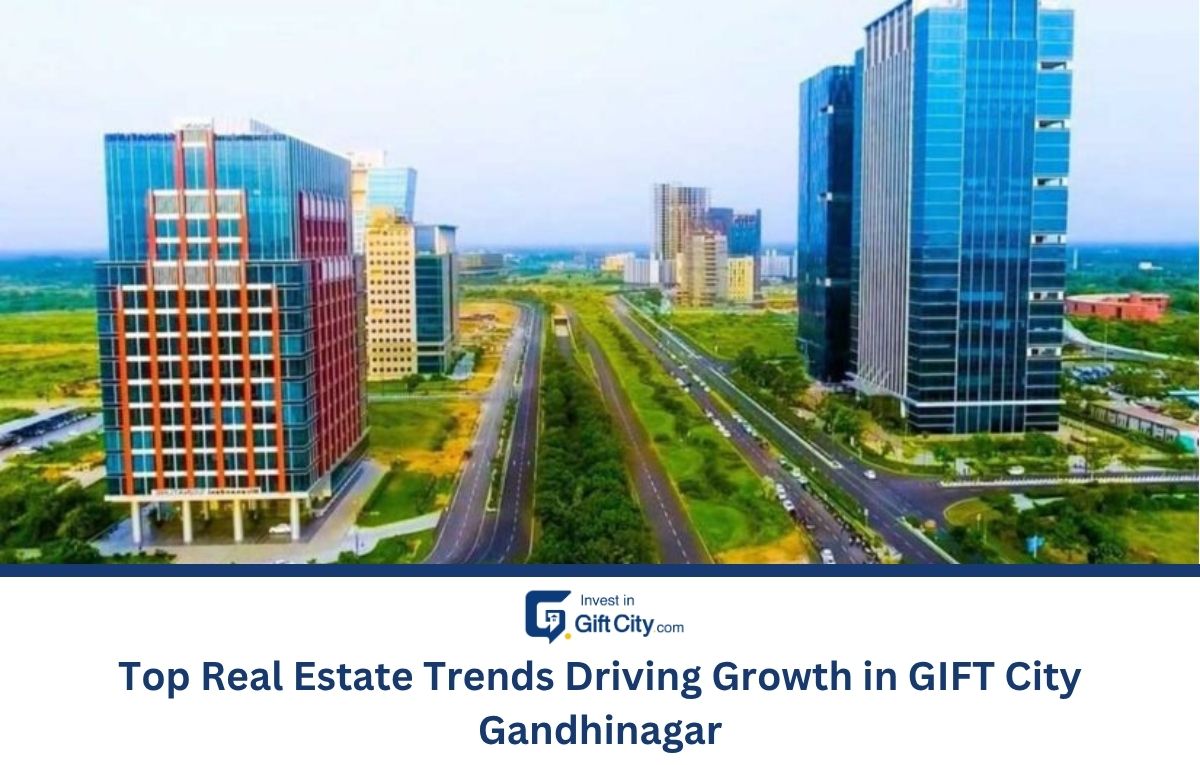

GIFT City — Gujarat International Finance Tec-City — is no longer just a vision on paper. Spread across 886 acres in Gandhinagar, Gujarat, this is India’s first operational International Financial Services Centre (IFSC) and one of the most ambitious urban development projects in the country’s history.
Over the last few years, GIFT City has transformed from a niche concept to a mainstream investment destination. Investors from Mumbai, Bangalore, Delhi, and across the globe — including a fast-growing NRI community — are paying serious attention to what is being built here.
So, what is driving this surge in interest? The answer lies in a combination of strategic government policy, global financial activity, modern infrastructure, and rapidly growing demand for both residential and commercial real estate.
In this blog, we break down the top real estate trends that are actively shaping the GIFT City Gandhinagar property market in 2026 and beyond.
One of the most powerful forces behind GIFT City real estate growth is the accelerating expansion of its IFSC. More than 600 entities — including international banks, insurance companies, global brokerage firms, and asset management companies — have already set up operations here.
Major global players such as JP Morgan, HSBC, Goldman Sachs, and several foreign universities have either established or announced a presence within GIFT City. This growing ecosystem is creating thousands of high-paying jobs, directly fueling demand for housing, retail spaces, and premium commercial offices.
For real estate investors, this means one thing: a stable, long-term tenant base. Wherever employment concentrations grow, property demand follows — and GIFT City is a textbook example of this pattern.
GIFT City residential projects are witnessing a significant shift in buyer profiles. The demand is no longer limited to local buyers. Executives, finance professionals, and C-suite employees relocating to GIFT City are actively looking for luxury apartments, serviced residences, and smart home solutions.
Developers are responding with integrated township projects offering world-class amenities such as concierge services, co-working spaces within the complex, clubhouses, rooftop gardens, and high-speed internet connectivity. Lifestyle-driven buying is now a dominant trend, where buyers are not just purchasing a home — they are buying into a community and a way of life.
Projects in the 2BHK and 3BHK segments in the mid-to-premium range have seen the highest traction, especially among professionals aged 30–45 who want to live close to their workplace within a secure, smart environment.
GIFT City property prices have seen consistent appreciation over the past three to four years, and current trends suggest this upward movement is far from over. Several key factors are contributing to this rise:
• Limited land availability within the GIFT City zone ensures restricted future supply.
• Ongoing infrastructure investment by both government and private developers is pushing up asset values.
• Strong investor confidence, backed by regulatory frameworks from IFSCA (International Financial Services Centres Authority), adds credibility.
• Increasing institutional and foreign investor participation is validating GIFT City as a global-quality real estate market.
Early investors who entered the market two to three years ago are already experiencing healthy capital gains. Analysts project continued appreciation of 10–15% year-on-year for premium segments in the near to mid-term.
For investors focused on passive income, GIFT City rental yield is one of the strongest in Gujarat and comparable to premium micro-markets in Mumbai and Bangalore.
The demand for rental housing is being driven by a unique combination of factors: a growing corporate workforce, expatriate employees from international firms, visiting professionals attending short-term assignments, and business delegates. This creates demand at multiple price points — from serviced apartments to long-term residential rentals.
On the commercial side, leasing of Grade A office spaces is robust, with international companies willing to pay premium rents for well-connected, fully-serviced offices within the IFSC zone. This has led to rental yields of 6–8% in some commercial segments, which is exceptionally high by Indian real estate standards.
GIFT City’s infrastructure story is one of its most compelling investment arguments. The city is not just a cluster of office buildings — it is a fully planned smart city with district cooling systems, underground utilities, dedicated fiber networks, and 24/7 uninterrupted power supply.
Key connectivity highlights include:
• Ahmedabad Metro Phase 2 extension connecting GIFT City to key hubs in Ahmedabad.
• SG Highway (Sarkhej–Gandhinagar Highway) offering quick access to Ahmedabad’s commercial districts.
• Proximity to Sardar Vallabhbhai Patel International Airport (approx. 30–35 minutes).
• Upcoming RRTS (Rapid Rail Transit System) corridor proposals that will further reduce travel times.
As connectivity improves, the catchment area for GIFT City widens, bringing in more residents, businesses, and investors — directly translating into higher property values.
NRI investment in GIFT City has surged in recent years, and for good reason. GIFT City’s IFSC framework allows NRIs to invest in rupee-denominated as well as foreign-currency-denominated products, access global financial instruments, and benefit from special tax incentives available only within the IFSC jurisdiction.
From an ease-of-doing-business perspective, GIFT City is perhaps the most NRI-friendly real estate destination in India. The regulatory environment is modeled after Singapore’s IFSC and Dubai’s DIFC, making it instantly familiar to globally-oriented investors.
NRIs from the US, UK, UAE, Singapore, and Australia are particularly active, driven by the dual advantage of India’s growth story and GIFT City’s unique international financial positioning.
Commercial property in GIFT City is experiencing a boom driven by the rapid growth of fintech companies, global banks, insurance intermediaries, and technology firms that are using GIFT City as their Indian or regional base of operations.
GIFT City office space demand has grown consistently, with occupancy levels in existing commercial towers reaching 85–90% in prime locations. New commercial developments are being pre-leased before construction completion — a strong indicator of future demand exceeding current supply.
Investors in commercial real estate here benefit from a unique combination of long-term lease agreements with creditworthy tenants, minimal vacancy risks, and above-average rental yields — making this asset class a compelling proposition for HNIs and institutional investors.
Unlike most Indian cities that have evolved organically, GIFT City was planned from scratch with sustainability at its core. The city employs district cooling technology (significantly reducing individual building energy consumption), underground utilities that remove the visual clutter of wires and pipes, integrated waste management, and a comprehensive traffic management system.
GIFT City is also pursuing green building certifications for its commercial and residential projects, making it one of the few cities in India where environmental sustainability is a developer mandate, not an afterthought.
For modern investors and buyers, especially younger professionals and globally-minded HNIs, sustainability is no longer a bonus — it is a baseline requirement. GIFT City meets this requirement fully, further differentiating it from conventional real estate options in Gujarat.
Looking ahead to 2030, the trajectory for GIFT City real estate is firmly upward. The government has committed to expanding the IFSC, adding more international universities and research institutions, and broadening the range of financial products available within the zone.
Residential demand is projected to grow substantially as more professionals relocate, and new phases of integrated residential townships come to market. Commercial real estate will continue to absorb demand from global companies looking for a regulated, tax-efficient, and operationally modern base in India.
Most importantly, those who invest early capture not just the current value, but also the compounding appreciation that comes with being in a developing market before it reaches maturity. GIFT City is still in its growth phase, which means the best entry opportunities may still be available — but the window is closing.
The biggest trends include rising property prices, increasing rental demand, growth of premium residential projects, commercial expansion, and strong NRI investment activity.
Yes, GIFT City is considered one of India’s fastest-growing investment destinations due to its IFSC status, infrastructure development, and growing business ecosystem.
Yes, property prices have shown significant appreciation over the last few years because of rising demand and limited supply.
Both residential and commercial properties offer strong potential, depending on investment goals and risk appetite.
Yes, increasing demand from finance, fintech, and multinational professionals is creating strong rental opportunities.
NRIs are attracted by international business opportunities, modern infrastructure, tax benefits, and long-term appreciation potential.
GIFT City Gandhinagar is not just riding a real estate wave — it is creating one. The combination of IFSC status, world-class infrastructure, growing employment, rising rental demand, and increasing global investor interest makes this one of the most exciting property markets in India today.
Whether you are a domestic investor seeking capital appreciation, an NRI looking for a high-ROI opportunity linked to India’s growth, an HNI diversifying into real assets, or a professional wanting to own a home close to work — GIFT City has something to offer.
The fundamentals are strong, the direction is clear, and the early-mover advantage is still available for those who act thoughtfully.